In the push for digital transformation, “integration” has become the ultimate buzzword in healthcare IT. Clinic groups naturally want their systems to talk to one another, and on paper, directly linking your clinical EHR to standard accounting software (like QuickBooks or Xero) sounds like the perfect shortcut to efficiency.
However, at CxSYS, our foundational philosophy—built by practicing clinicians who have scaled massive clinic groups—is different. While CxSYS bridges clinical care with financial operational workflows, we firmly advocate against the direct, unmediated integration of external accounting systems into the core EHR environment.
True financial stability in a healthcare enterprise requires a protective buffer between your daily clinic floor and your corporate general ledger. Here are the core reasons why a direct architectural link is a fundamental risk to your operations, data integrity, and compliance.
1. The Human Factor: Clinical Staff are Not Accountants
In the real world of clinic operations, your front-desk and clinical staff are hired for their patient care and administrative skills—not their understanding of GAAP (Generally Accepted Accounting Principles).
It is incredibly common for busy clinic staff to confuse foundational accounting concepts, such as the distinct differences between a receipt, an invoice, and a statement. Furthermore, front-desk staff turnover in healthcare can be notoriously high, making the continuous, deep financial training of new hires unsustainably expensive.
CxSYS solves this by acting as a powerful internal control mechanism. It creates a necessary operational gap, providing built-in guardrails that catch and correct human entry mistakes before they ever touch your official financial records.
2. The Fluid Nature of Medical Billing (The TPA Factor)
Unlike standard retail operations where a sale is final at the point of purchase, medical billing is highly volatile. Clinics deal constantly with Third-Party Administrators (TPAs) and corporate insurance panels.
Consider a standard scenario: a patient receives care, and a claim is submitted to a TPA. Days or weeks later, the TPA denies a portion of that coverage. Your clinic staff must then alter the charges, adjusting the claim and shifting the remaining balance to the patient to pay out of pocket.
If these “sales” are transmitted to an external accounting system too early, your books will be flooded with premature data, leading to inaccurate reconciliations, mismatched figures, and financial misrepresentations. CxSYS holds these operational fluctuations internally, allowing data to settle into reality before pushing it forward.
3. The Danger of “Two-Way Sync” and Audit Penalties
Many IT providers promise a “seamless two-way integration” where changes in your accounting software reflect back into your EHR, and vice versa. In practice, this is a recipe for an audit nightmare.
A two-way pipeline means that an adjustment made by an accountant in an external financial system can push backward into the EHR, disrupting and overriding information that the clinic floor has already finalized and “accepted.” This triggers a never-ending, automated tug-of-war of adjustments between the two systems. When auditors step in to track the source of truth, this systemic loop makes clean reporting impossible, exposing your clinic group to severe audit penalties.
4. Operational Finance vs. Corporate Accounting
An accounting system needs to know how much revenue was generated today; it does not need to know which specific patient bought a specific brand of medication at 2:15 PM.
Direct integration floods your corporate accounting software with thousands of micro-transactions, bloating your general ledger and making macro-level financial oversight incredibly clunky. CxSYS cleanly divides these worlds:
-
Operational Finance (handled in CxSYS): Point-of-sale, inventory tracking, doctor commissions, and TPA claims.
-
Corporate Accounting (handled by your financial team): Tax compliance, corporate balance sheets, and overall profit/loss.
5. The Power of the “Aggregated Sub-Ledger” Approach
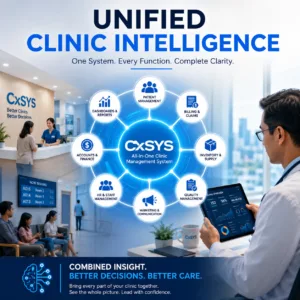
Instead of opening a direct, vulnerable database pipe, CxSYS utilizes an architecturally sound Aggregated Sub-Ledger approach.
CxSYS acts as the master operational engine, managing the high-volume, chaotic daily transactions across all your clinic branches. At the end of a designated financial period, CxSYS compiles this operational data into clean, anonymized, and aggregated financial summaries. This summarized data is what moves over to your accounting platform. Your finance team gets the exact figures they need for corporate accounting, while your patient data remains securely locked behind the clinical firewall.
6. Compliance and Patient Privacy (PHI)
Financial accounting platforms are designed to track dollars and cents—they are not built to handle Protected Health Information (PHI) or comply with stringent medical data privacy laws. Directly coupling these systems creates a compliance trap where patient identities and specific clinical treatments risk leaking into standard financial software endpoints. If your external financial platform suffers a breach, your sensitive medical data is suddenly exposed.
The CxSYS Verdict
True integration doesn’t mean making every software application see every piece of data. True integration means contextual awareness.
CxSYS was built by doctors who understand that clinic efficiency cannot come at the expense of financial accuracy or system stability. By managing operational finance internally and keeping corporate accounting systems at a safe, aggregated distance, CxSYS gives you the best of both worlds: flawless business visibility and bulletproof clinical security.
About the Author
Dr. Pasupathi is the founder and chief architect behind CxSYS. Having spent years operating and expanding Malaysian private clinic networks, he combines clinical experience with deep expertise in healthcare operations, finance, compliance and digital transformation. His articles focus on helping clinic owners build sustainable, data-driven healthcare organisations.