In the early phases of running a clinic, the instinct for many owners is to divide and conquer — separating business functions such as Accounting, HR, Procurement, and Inventory into isolated teams or systems. Often this advice comes from specialists: accountants recommend their tools, HR professionals recommend theirs, and procurement follows suit.
At face value, it seems efficient. However, for healthcare — especially in Malaysia’s dynamic clinic landscape — this siloed approach is a trap that creates operational “tunnels” where each department works intensely within its own scope without a unified view of the clinic’s true performance and needs. Unlike many traditional industries, healthcare’s core operations cannot survive in disconnected fragments.
Healthcare is Not Like Other Industries
In manufacturing or retail, separating departments may be manageable because outputs and revenue flows are relatively linear and predictable. But in healthcare, clinical care and business operations are deeply intertwined:
-
Decisions about staffing affect patient wait times.
-
Inventory levels influence both patient safety and revenue.
-
Billing, HR incentives, and clinical throughput are interdependent.
When these functions are run in isolation, each department produces its own story. An accountant may present a seemingly healthy balance sheet. HR may report strong staffing compliance. Procurement shows efficient stock orders. But when the clinic owner tries to stitch these narratives together — the composite picture is often totally different from reality.
This fragmented view leads to poor decision-making, lost opportunities, and frontliners — especially nurses, doctors, and support staff — bearing the brunt of misaligned requirements.
What Happens When Departments Work in Tunnels
Departments entrenched in their own tools and workflows inevitably focus on tasks within their small universe. There’s little incentive or capacity to look beyond:
-
Redundant requirements cascade onto frontliners.
-
Administrative friction increases as staff chase approvals across systems.
-
Workplace frustration grows because no single system reflects the true clinic story.
Management teams may proudly claim “efficiency” because individual KPIs improve — but what often happens is the actual workload simply gets shifted downstream. The clinic does not become more efficient; it becomes more complicated for the very people delivering care.
And in healthcare, unlike other sectors, the frontline — the doctors, nurses and allied health staff — are the true knowledge holders of the business. If their tools do not support clarity and ease of work, the whole operation suffers.
CxSYS — The One System That Unifies Everything
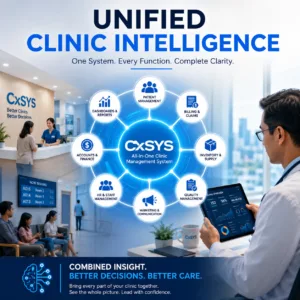
That’s where CxSYS changes the game. Rather than splintering operations into multiple systems that never quite talk to one another, CxSYS integrates clinic management into a single, powerful ERP + EHR platform designed specifically for healthcare workflows.
Unified Operations, Real-Time Clarity
CxSYS brings together:
-
Clinical workflows (EHR, appointments, billing)
-
Accounting with full double-entry and direct LHDN e-Invoicing
-
HR and payroll (including EPF/KWSP, SOCSO/PERKESO automation)
-
Inventory and procurement, with expiry alerts and automated purchase orders
-
Multi-clinic oversight from one dashboard
-
QMS, reports, marketing, mobile access, and more
All modules work from the same database and interface, so there’s no reconciling different numbers from different systems — the data is accurate, consistent and instantly available.
Empowering Doctors, Supporting Frontliners
Doctors already think about a thousand clinical things every day — they shouldn’t have to worry about toggling between four or five systems just to run their practice. Every extra login, every report generated separately, every reconciliation meeting, steals precious attention away from patient care.
CxSYS removes these cognitive and attention taxes. It centralizes workflows so doctors and nurses can:
-
Focus on clinical decisions.
-
See financial impacts of actions in real time.
-
Reduce friction that traditionally happens when departments are misaligned.
This creates a rewarding work environment where frontliners feel appreciated — because their work actually feeds into the system and shows up in management dashboards without delay.
Built for Growth — From Small Clinics to Multi-Site Practices
In small clinics, these issues might not immediately feel painful. But if your goal is to grow your practice, you need a foundation that scales without creating chaos. Culture and workflows are extremely hard to fix once bad habits are established.
CxSYS enables:
-
Centralized reporting across linked clinics.
-
Shared patient records (with permissions).
-
Standardized inventory and reconciliation.
-
Greater operational visibility for owners and HQ teams.
This means streamlined operations even as your practice grows in size, complexity, or geographical spread — something fragmented tools simply cannot deliver.
Stop Hiding Complexity — Embrace True Clarity
Some argue that integrated systems like CxSYS are “heavy” — but here’s the truth: healthcare itself is complex. The real mistake is trying to hide that complexity under multiple disconnected “simple” tools that pretend to be user-friendly. What these tools actually do is push complexity onto your people.
CxSYS doesn’t hide the complexity — it visualizes it. It brings messy clinic data into one source of truth so that you can make strategic, confident decisions without guesswork.
In conclusion, avoiding operational tunnels isn’t just a business cliché — it’s a strategic imperative for clinics that want to thrive. With CxSYS, Malaysian clinics gain clarity, transparency, frictionless operations, and rewarding work experiences for frontliners and owners alike.
For doctors aiming to focus on what matters most — patient care and sustainable growth — CxSYS isn’t just software… it’s your partner in running a modern, resilient clinic.
About the Author
Dr. Pasupathi is the founder and chief architect behind CxSYS. Having spent years operating and expanding Malaysian private clinic networks, he combines clinical experience with deep expertise in healthcare operations, finance, compliance and digital transformation. His articles focus on helping clinic owners build sustainable, data-driven healthcare organisations.